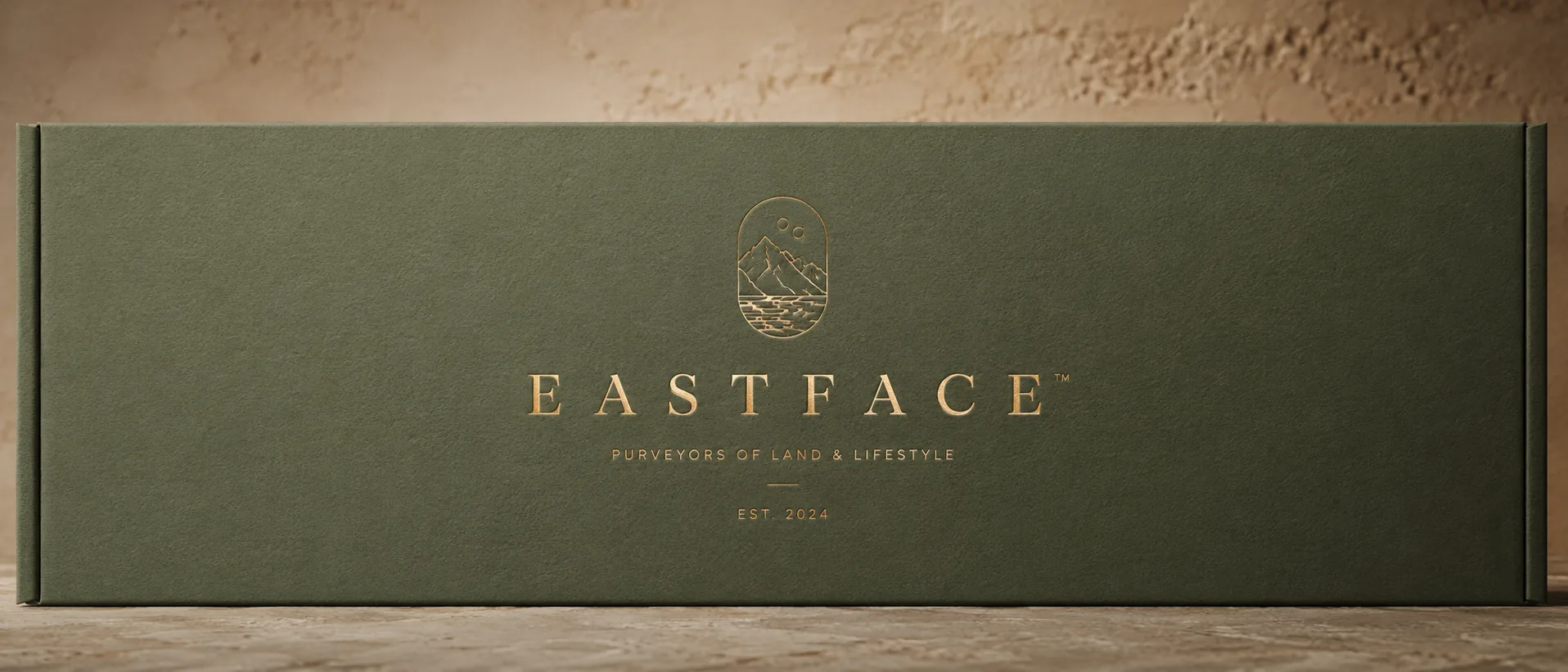
FINISHES
Foil stamped boxes
Hot foil stamping transfers a metallic or pigmented foil onto a folding carton with a heated metal die and pressure. The foil bonds only where the die touches the board. Gold, silver, rose gold, holographic and matte foils are standard, and one die can carry foil and an emboss together.
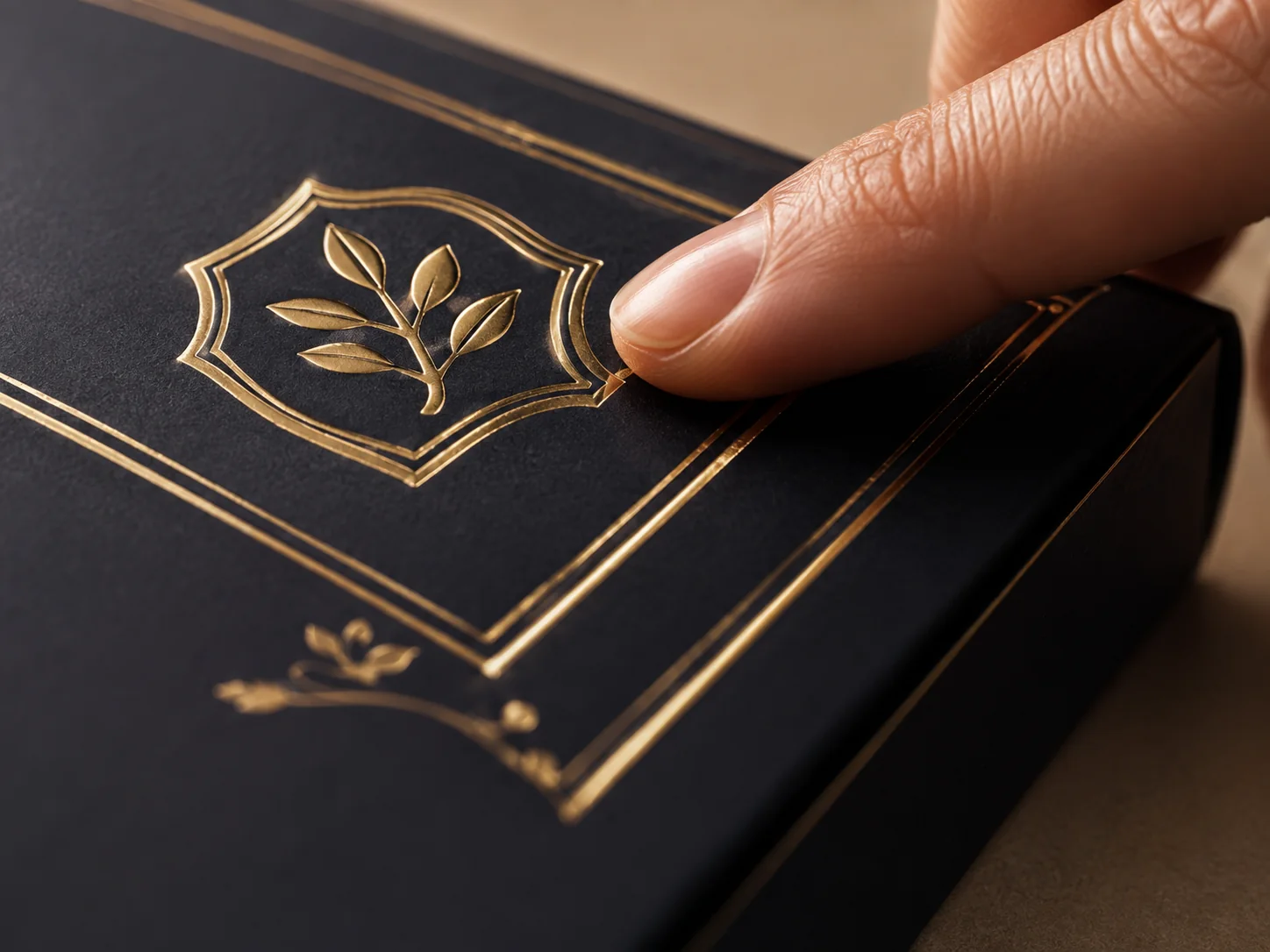
Tooling
One die per design
Cut from your artwork. One tool can carry the foil and an emboss together.
Sequence
The last pass
After printing, after any film, as its own hit. Nothing prints on top of foil.
Range
Gold to holographic
Six foils on the shade card. Same operation and same price across all six.
Best at
Small marks, fine detail
A crest, a wordmark, hairline rules. Coverage is what costs.
How the foil gets onto the board
Foil is a transfer rather than an ink, and the whole of that claim is in the last two frames: the web carries foil across the entire sheet and leaves it only where the heated die made contact.
A cross-section showing how foil is stamped onto a carton, in 4 steps.
- Printed board. Printed, and laminated where the job calls for it. Foil goes on after the film, which gives the transfer a sealed surface to key into.
- The web and the die. A roll foil runs across the whole sheet under a heated metal die. The web is continuous; what decides where foil lands is the shape cut into the tool above it.
- Heat and pressure. Temperature, pressure and dwell are set once at make ready and hold for the run. Patchy foil is under-transferred and a halo is too much of one of the three.
- The web lifts away. The foil bonded only where the die touched, and the rest leaves on the web. Nothing prints over the result, which is why type crossing a foil area is drawn as a hole in the foil.
01Printed board
Printed, and laminated
Cross-section, magnified. Not to scaleHover a layer to name it
01/04Step through it
Hot foil stamping specification
Foil is a transfer, not an ink. Every finish this plant runs is set out the same way.
The mark and the die
- Foil families
- Pigment, metallic, holographic, matte and tint. Gold, silver and rose gold are specified most often.
- Combination foil and emboss
- One die, one hit. The foil lands on the raised area. See embossing and debossing.
What it sits on, and what happens after
- Over gloss or matte lamination
- Yes, and it is the usual order. Film goes on first, foil on top of it.
- Over UV coating
- The coating is knocked out of the foil area in the file. Foil will not bond to a cured UV surface.
- Recycling
- The foil layer is not fiber and does not repulp. Fine on a crest. Across a whole panel, worth raising with your recycler.
- Also called
- Foil stamping, hot stamping, hot foil.
Fine serif type and hairline rules are the usual problem on a foil job. Under a certain width a stroke fills in or breaks up, and so does a gap that is too tight. Both can be found in the file before the die is cut.
Send the artwork before the die is cut
We mark every stroke and gap sitting under what a foil die will hold, and say how much each one has to grow.
Hot foil vs cold foil vs metallic ink
Three ways to put metal on a carton. They are quoted differently and they do not look the same.
| Compared on | Hot foil stamping | Cold foil | Metallic ink |
|---|---|---|---|
| How it is applied | A heated die presses foil onto the board in its own pass | An adhesive is printed on press and foil is laminated to it in line | Metallic pigment is printed as an ink through a normal press unit |
| Sharpness of edge | Sharpest. The die edge is the foil edge | Good. Limited by the printed adhesive, not by tooling | Softest. It is an ink |
| Available finishes | Metallic, pigment, holographic, matte, tint | Metallic, and it can be overprinted to make other metals | Metallic golds, silvers and bronzes |
| Tooling | A die per design | No die, a plate | No die, a plate |
| Best run length | Short and medium runs, and any run carrying a crest or fine mark | Long runs with large or repeated metallic areas | Any run where metal is a color and not a surface |
| Look on dark board | Reads as metal | Reads as metal, slightly flatter than hot foil | Reads as a gray or tan ink |
A fourth route is a board, not an operation. Where the metal is the background, use full coverage metallic board. It prices on a different basis from all three above.
How foil stamping runs here
Foil goes on last
The pass sits after printing and after any film. On a carton carrying lamination, foil and a spot gloss, that order is settled in prepress and not on the floor. Every layer needs a surface it can bond to.
Three settings at make ready
Temperature, pressure and dwell. Patchy foil has been under-transferred. A halo has been held too long or pressed too hard. Once the three are set they hold for the run, so a hundred cartons and ten thousand come off the same way.
Foil and relief run as one tool
Where a design carries both, a combination die puts the foil onto the raised area in a single hit. There is no second pass to register to.
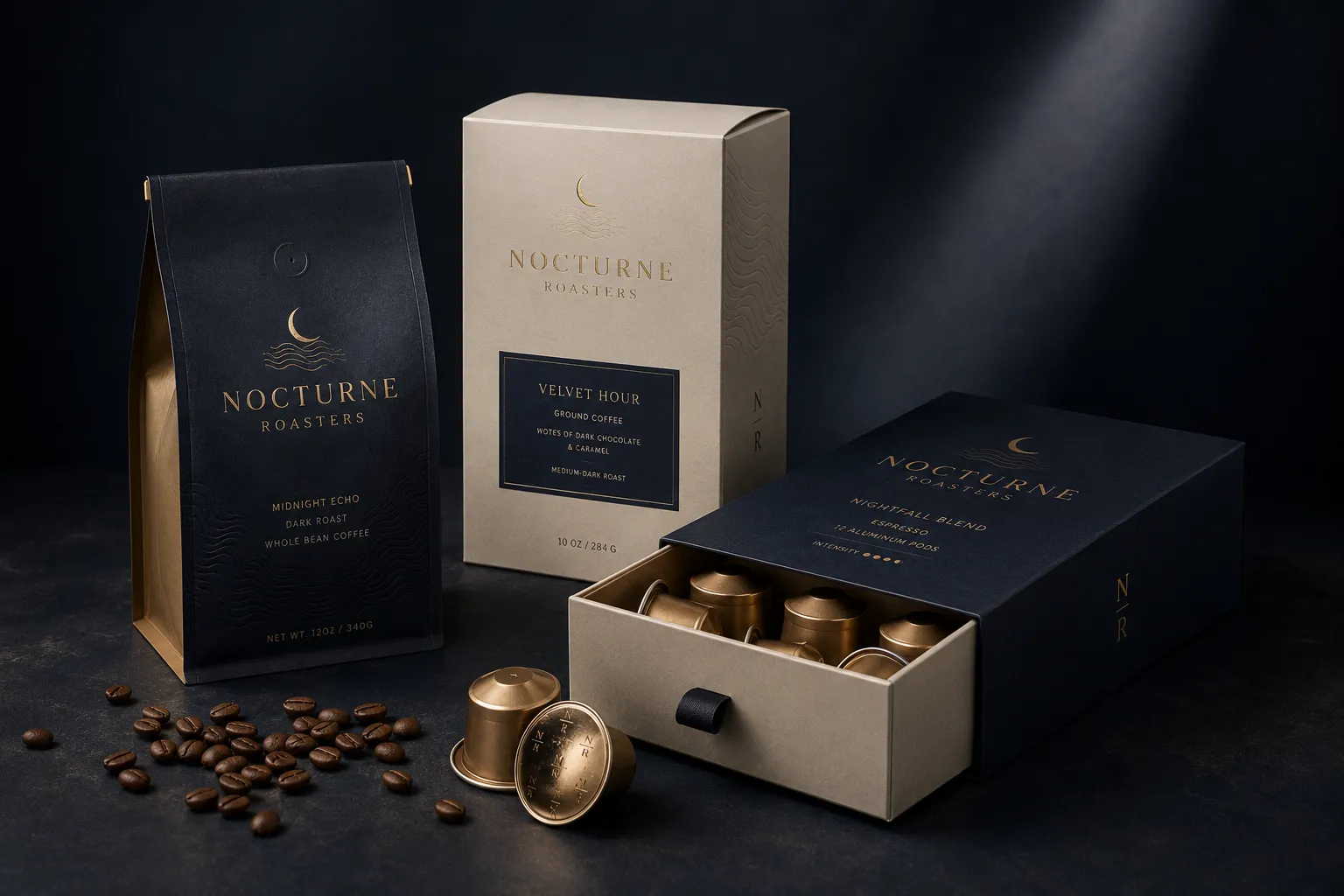
Gold, rose gold and holographic on one board
Four panels: gold, rose gold and holographic on matte laminated board, and one combination foil and emboss. Holographic does not photograph. You have to tilt it.
Foils we run
06
- Gold, in the swatch kit
- Rose gold, in the swatch kit
- Silver
- Copper
- Holographic, in the swatch kit
- Matte black
Ruled in gold: goes out in the kit
Cost logic
Cost is driven by the area the foil covers and by whether the die is single or multi level. It is not driven by the color of the foil.
Area moves the number. Past a certain coverage, a metallic board reaches the same look for less.
What it costs against a US supplier
Landed cost runs 20 to 30 percent below a comparable US supplier quote. That is one price: board, printing, finishing, tooling, import duty, shipping and delivery to your door, with nothing added later.
Get a quoteWhen to foil, when not to
Use it when
The metal has to read as metal.
Foil is metal sitting on the surface. On dark board a printed gold is barely there.
The mark is small and the detail is fine.
A crest, a wordmark, a set of hairline rules. Coverage stays low and so does the cost.
Relief is wanted with it.
One tool, one hit. Cheaper and cleaner than running foil and emboss as two passes.
Do not use it when
The design needs something printed on top of it.
Nothing prints over foil. Text crossing a metallic area has to be drawn as a hole in the foil.
The type is finer than the die minimum.
A hairline serif fills in or breaks up, and on a finished carton it reads as a printing fault. The fix is a heavier stroke.
Metal is the background and not the mark.
Foil is priced by coverage. A full metallic panel costs more in foil than a metallized board costs as a substrate.
Where foil goes, by category and structure
A small area finish, mostly used on the face of a pack. The last column is where the foil usually lands.
Holographic foil on this page is decorative. Holography used to prove a carton is genuine is specified against a counterfeiting risk: see holographic features used for authentication.

| Category | Structure it usually sits on | Where the foil goes |
|---|---|---|
| Fragrance | Tray and sleeve, or a sleeve on its own | Wordmark and rule on the sleeve face, combination die with an emboss |
| Spirits | Tray and sleeve, hinge lid | Crest and neck band detail, usually over a matte film |
| Prestige confectionery | Tray and sleeve, four corner | A repeated line pattern instead of a solid, so coverage stays low |
| Supplements | Straight tuck end | A single wordmark, where foil competes with legibility |
| Holographic packaging | Sleeve, hinge lid, counter display | A defined shape instead of a flood. The effect needs an edge |
Questions about foil stamping
A heated metal die presses a roll foil against the board, and the foil releases onto the surface only where the die makes contact. It is a transfer, not a print. It reads as metal, and nothing can be printed over it afterwards. Gold, silver, rose gold, holographic, matte and pigment foils all run the same way.
Yes, and it is the most common arrangement on a finished carton. The film goes on after printing and the foil goes on top of it, which gives the transfer a smooth sealed surface to key into. Soft touch needs care, because a transfer bonds poorly to the nap. A UV coated area has to be knocked out of the coating at artwork stage, since foil will not bond to cured UV.
Hot foil uses a heated die and its own press pass, so the edge is as sharp as the tooling and the foil can carry relief in a combination die. Cold foil prints an adhesive on press and laminates foil to it in line, so it needs no die and can be overprinted to build other metallic colors. Hot foil suits a small mark with a crisp edge. Cold foil suits wide metal on a long run.
Holographic foil is stamped exactly like any other foil, with the same heated die and the same pass. What differs is the foil itself: the release layer carries a microscopic diffraction grating, so it splits light into color and the color moves as the pack is turned. It is specified for holographic boxes and holographic packaging as a decorative effect, and it works best as a defined shape with an edge, not as a flood. Holography used to prove a carton is genuine is a different specification and lives on the anti-counterfeiting page.
Vector artwork with the foil on a layer of its own, and type on that layer converted to outlines, since the die is cut to a path. Anything that has to appear over a foil area is drawn as a knockout in the foil, because nothing prints on top of it. Tell us what the foil sits on as well: uncoated board, gloss film, matte film, soft touch and UV coating are five different surfaces to bond to and they set the order of the passes. Send it in whatever state it is in and we will come back with what has to change.
The board is, and the foil layer is not fiber, so it behaves as a contaminant in the repulping stream. On a small crest most streams handle it. Across a whole panel it makes the carton harder to process, though not unrecyclable, and at that coverage a metallized board is usually the better choice.
Last reviewed
Order foil swatches
Swatches go out in gold, rose gold and holographic on matte laminated board, with one combination foil and emboss panel. Send the artwork with the request and the stroke check comes back with them.