MATERIALS
Art paper and art card
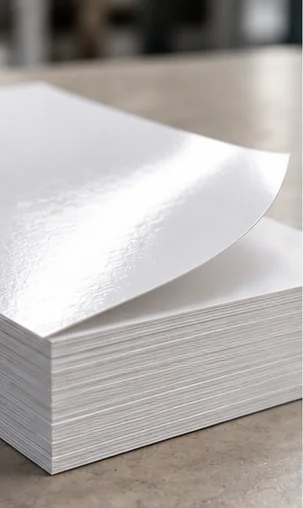
Art paper is coated woodfree paper, clay coated on one side or on both to take print. At about 230 gsm and above the same stock is sold as art card or art board, and that is the weight a folding carton is cut from. US mills sell both as coated paper, C1S or C2S.
The name is the Asian and British one. The stock is what a US quotation calls coated, and translating between the two is most of what this page does.
Fiber
Bleached, woodfree
Chemical pulp with no mechanical fiber in it at all.
The US name
Coated paper
Art paper, art card and art board are the same stock renamed.
Coating
C1S or C2S
One face or both. A carton almost always wants one.
Where it folds
From about 230 gsm
Lighter than that it is a wrap, a label or an insert.
What is inside a sheet of art card
One bleached body and a mineral coating on it, which is the same construction as SBS. What this drawing shows that the SBS one does not is the second coating: art paper and art card are sold coated one side or coated two sides, and on a C2S sheet the reverse is the same surface as the face.
Art paper and art card: where the line is
One material, two names, and the thing that separates them is weight. The sheet stops being a paper and starts being a board somewhere around 230 gsm, which is where it begins to hold a crease instead of just taking a fold.
| Compared on | Art paper | Art card, also art board |
|---|---|---|
| Grammage | 90 to about 200 gsm | About 230 to 450 gsm |
| Caliper | Under about 8 pt | About 9 to 18 pt |
| What it is | A printing paper. It folds, and it will not hold a panel upright | A paperboard. It creases, folds and stands up |
| What it makes | Leaflets, inserts, labels, bag faces, and the printed wrap on a rigid box | Folding cartons, sleeves, hang tags and covers |
| The coating | Usually both sides, because both sides are read | Usually one side, because one side is seen |
| What a US quote calls it | Coated text, or coated paper | Coated cover, C1S or C2S |
The material is identical on both sides of that line. What changes is the weight, and the weight is what decides whether a sheet stands up or lies down.
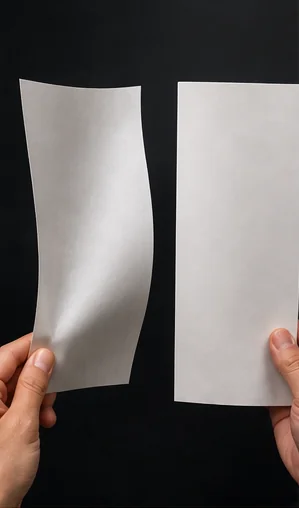
Art paper and art card are one coated surface at two weights. Only the heavier one folds into a carton.
Art card weights, in gsm and in points
US buyers specify caliper in points, where a point is one thousandth of an inch. Overseas quotations specify grammage in grammes per square meter. These are the ranges a folding carton is ordered in, in both.
| Grammage | Caliper | What it suits |
|---|---|---|
| 230 to 250 gsm | About 9 to 10 pt | Sleeves, hang tags, light inners and card backing |
| 250 to 300 gsm | About 10 to 12 pt | Small cosmetics cartons, sachet cartons, folding covers |
| 300 to 350 gsm | About 12 to 14 pt | The common folding carton range. Most retail cartons are somewhere in it |
| 350 to 400 gsm | About 14 to 16 pt | Supplement and bottle cartons, and cartons carrying real weight |
| 400 to 450 gsm | About 16 to 18 pt | Large cartons, crash lock bases, and trays that resist a crush |
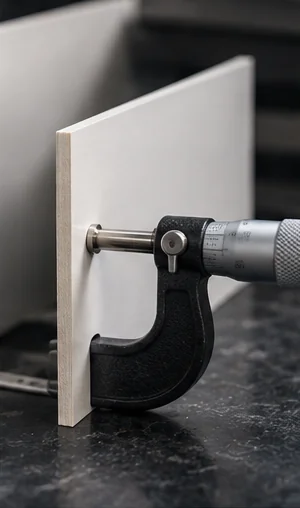
Every caliper here is approximate, and it has to be. Grammage is weight and caliper is thickness, and the two are related by bulk, which changes between mills and between a gloss and a matte finish on the same mill's stock. Coated woodfree sits low on that range because the mineral coating is dense, so a sheet of art card measures thinner than a sheet of SBS at the same grammage. Which caliper a particular carton wants is settled at structural design against the filled product weight, and the recommendation comes back in both units.
Art card and SBS are the same argument
These are not two boards. They are one class of board with two names, and which name is used depends on where the mill is.
Both are solid bleached chemical pulp with a clay coating on the print face. Neither has a middle ply of a different furnish, which is what separates both of them from FBB, and neither has any recovered fiber in it, which is what separates both of them from duplex board and chipboard.
What genuinely differs is bulk. SBS is bulkier for its weight, so a sheet of SBS at a given grammage measures thicker than a sheet of art card at the same grammage, and stiffness follows thickness rather than weight. A carton specified as 300 gsm art card and a carton specified as 12 points of SBS are close, and they are not the same carton. The substitution is made at structural design against what the pack has to hold, not on a conversion chart.
Order it under either name. What arrives is decided by the caliper, the coating and the print, and not by which word was on the purchase order.
- Same furnish
- Bleached chemical pulp, no mechanical middle, no recovered content.
- Same coating decision
- C1S and C2S mean the same thing on both, and the SBS page sets the choice out in full.
- Different bulk
- Art card is the denser of the two, so it measures thinner at the same grammage.
- Different paperwork
- One is quoted in gsm and one in points, which is the only difference most buyers ever meet.
Gloss art and matte art
The coating comes in two surfaces and the choice is made before any finish goes over it.
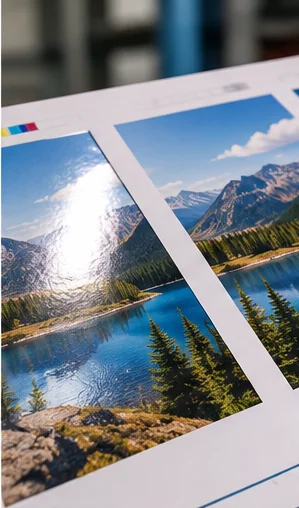
Gloss art holds the highest ink density in this set. The coating closes the fiber so the ink sits on top of the sheet rather than sinking into it, which keeps the dot sharp, the solids deep and fine reversed type open. It is the reference surface for a photographic image.
Matte art is the same body with a matte coating. It scatters the light instead of returning it, so a solid looks flatter and a page of small type is easier to read for longer. It also marks more readily: a fingernail drawn across a matte coated solid leaves a burnish that a gloss sheet would not show.
Neither of them is the finish. A lamination, a varnish or a spot UV goes over the coating and changes the surface again, and a matte laminated gloss art sheet and a plain matte art sheet are two different objects that photograph identically. The board decides the starting point and the finish decides the rest.
When art card is the right call
The grade is a print surface first. Where the print is not what the carton is being judged on, something else in this cluster is usually the better buy.
Specify it for
- Photographic artwork and fine reversed type
- The coated surface holds the smallest dot and the tightest reverse of anything in this cluster.
- A carton whose graphics carry the pack
- Cosmetics, confectionery and gift cartons, where the printed face is the product on a shelf.
- A printed wrap over a rigid box
- At 128 to 157 gsm the sheet turns a corner without cracking and still prints photographically.
- Matching a quotation written in gsm
- A stock named in grammage can be specified, proofed and run here without being converted first.
Specify something else for
- A large carton that has to stand up light
- Solid coated fiber is heavy for its stiffness. FBB reaches the same stiffness at a lower weight.
- A carton under about 230 gsm
- It takes a fold and it will not hold a panel. The flaps will not stay shut and the pack will bow on a shelf.
- A recycled content claim on the pack
- Art paper is virgin bleached fiber. Duplex board or chipboard is where that claim belongs.
- A deep fold that has not been creased
- Coated woodfree cracks along an uncreased fold, and the coating shows the crack as a white line.
Art card as specified here
How an art card carton is specified here, field by field.
On the sheet
- Printing
- Offset litho on a six-color Komori line, with the coating unit inline.
- Coating
- Aqueous or UV to the job.
- Inks
- Vegetable based, low VOC.
- Color standard
- Matched under D65 and TL84 viewing conditions against your existing standard.
- Incoming checks
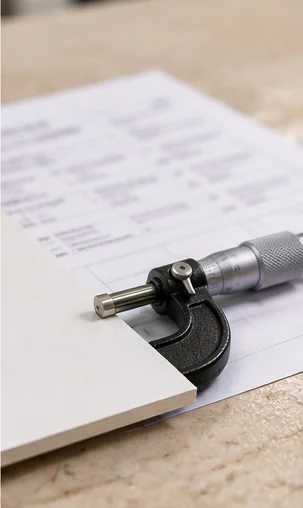
- Every pallet is weighed and gauged at goods-in against what the docket says, so a sheet ordered in grammage is checked in points before it reaches the press.
Art card against the other five
Art card is the coated bleached end of the range, and it competes with SBS on print and loses to FBB on stiffness per dollar. Where the pack is being judged on the image, it is worth the weight. Where it is being judged on standing up, it is not.
Read next
Questions about art paper and art card
Art paper is coated woodfree paper: bleached chemical pulp with a mineral clay coating laid over it, on one side or on both. The coating closes the surface so ink sits on top of the sheet instead of soaking into the fiber, which is what gives a sharp dot, deep solids and open reversed type. The name is the one used across Asia, India and the UK. A US mill sells the same stock as coated paper, and on a quotation it appears as coated text, coated cover, C1S or C2S. It comes in a gloss and a matte surface, and both are the same body under two different coatings.
Weight, and nothing else. They are the same coated woodfree material. Art paper runs from about 90 to about 200 gsm and behaves as a printing paper: it folds but it will not hold a panel upright, so it is used for leaflets, inserts, labels, bag faces and the printed wrap on a rigid box. From about 230 gsm upward the same stock is sold as art card or art board, which is a paperboard: it creases, folds and stands up, and it is what a folding carton is cut from. Art card and art board are two names for the same thing, and neither is a different material from art paper.
Most folding cartons sit between 300 and 350 gsm, which is roughly 12 to 14 points of caliper. Sleeves, hang tags and light inners run 230 to 250 gsm; small cosmetics and sachet cartons 250 to 300; supplement and bottle cartons and anything carrying real weight 350 to 400; and large cartons, crash lock bases and crush-resistant trays 400 to 450. Those caliper figures are approximate on purpose, because grammage is weight and caliper is thickness and the two are related by bulk, which varies between mills. Which one a particular carton wants is decided against its filled weight at structural design rather than taken off a chart.
C1S and C2S describe how many sides of the sheet are coated, so they are a specification of art paper rather than an alternative to it. C1S is coated one side and C2S is coated two sides. Art paper at leaflet weights is usually C2S, because both sides of a leaflet are read. Art card at carton weights is usually C1S, because only the outside of a carton is printed and the uncoated reverse takes glue better during folding and gluing. Paying for C2S on a carton is only worth it where artwork is printed on the inside of the pack and has to hold fine detail.
They are the same class of board under two names. Both are solid bleached chemical pulp with a clay coating on the print face, with no middle ply of a different furnish and no recovered fiber. The real difference is bulk: SBS is bulkier for its weight, so a sheet of SBS at a given grammage measures thicker than a sheet of art card at the same grammage, and stiffness follows thickness rather than weight. That means 300 gsm art card and 12 point SBS are close but not interchangeable on paper, and the substitution is made against what the carton has to hold at structural design. In practice the name on the order matters much less than the caliper, the coating and the print specification underneath it.
Last reviewed
Send the specification in whichever unit it arrived in
A grammage, a caliper, or a sample carton. What comes back names the stock in both units, with the coating called against what is being printed and the bulk difference stated where it changes the caliper. Board samples go out on request. Landed cost runs 20 to 30 percent below a comparable US supplier quote.