Straight tuck end
The usual host. Both flaps to the rear, so the front panel under the tab is unbroken.
See the structure: Straight tuck endFOLDING CARTONS
A hang tab box is an ordinary folding carton with an extension above its top panel, folded back on itself and slotted, so the carton hangs from a peg hook while still standing on a shelf. The tab is part of the same blank, not a sticker applied afterwards.
Any construction here can carry one. What changes is where the tab hangs from and how much board is under the slot.

Above the top panel, the tab comes up as an extension of the back panel, folds back down on itself, and the slot is cut through where the two thicknesses meet.
How a hang tab carton is made, in five steps.
Drawn to illustrate the structure. Your dieline is developed to your product, free, before you commit. The blank drawn here is a tuck end with a tab on it. The tab is a modification and it can go on any of the constructions in this range.
Ask for a structural designThe body folds like any tuck carton. What is different is above it: an extension standing up in the plane of the back panel, folded back on itself so that the hole ends up cut through two layers of board rather than one.
A euro slot cut in a single thickness tears out under the weight of a full carton after a few dozen shoppers have lifted it off the peg and put it back. Two thicknesses, glued face to face, do not.
All three cost the same to cut. Each suits a different peg wall.
The default. The narrow neck below the hole is what holds the carton square on the hook. Specify this unless there is a reason not to.
Fits more hooks. The converging sides seat on a wider range of diameters, and the tab can be shorter. It swings a little more, which shows on a heavy pack.
Angles the face down. A crease below the slot, so the carton stands proud of the wall. For a peg wall above eye level.

A slot cut in one thickness of board holds on the pallet and tears on the peg, after a few dozen shoppers.
The load on a hang tab is small and repeated, and board handles repeated load badly.
A full carton on a peg hook weighs almost nothing, but the slot carries that weight lifted and dropped hundreds of times, each time with the edge of a steel hook bearing on one small arc of board. Single thickness board creases at that arc, then delaminates, then tears.
Folding the tab back doubles the board at that arc, and gluing the two faces together stops them working against each other. The slot is then cut through both layers at once, so the two are always in register. The internal corners of the slot are radiused, because a sharp corner is where a tear starts, on the die cutter and on the peg.

A hang tab carton still works on a shelf. On a multi-retailer program the same SKU often does both.
| Plain carton | Hang tab carton | |
|---|---|---|
| Peg display | Needs an applied hook or a header card | Hangs directly, with nothing added at the pack stage |
| Shelf display | Stands and stacks | Stands and stacks. The tab folds flat behind the carton |
| Board on the sheet | The carton and nothing else | The carton plus the tab, which is cut twice its finished height |
| The face | Full panel, top to bottom | The same, with the tab reading as part of the design above it |
| Failure to design out | None on this axis | Slot tear-out, answered by the fold-back rather than by heavier board |
| Retail compliance | Whatever the shelf requires | Peg spacing and hook diameter, which vary by retailer and are worth confirming first |
The tab is cut to roughly twice its finished height because it folds back on itself, so it costs board even on the runs that end up on a shelf. On a program split across peg and shelf accounts that is usually still cheaper than two dielines.
A hang tab carton has one visible failure that has nothing to do with strength: it hangs crooked.
The carton hangs from one point, so it turns until its center of mass is directly below the slot. Center the slot on a pack whose weight sits to one side, and it hangs at an angle for the whole of its retail life.
So the slot is placed against the loaded carton, not against the blank. Send the product, say how it sits inside, and the slot goes where the pack balances, which is not always the middle of the tab.
Two constraints sit either side of that. The slot needs enough board above it that the tab does not tear out at the top edge, and enough board below it for the fold-back to be glued to. Between them there are usually a few millimeters to work with, and these are settled at structural design.
Slot centered on the tab
The pack hangs at an angle for its whole retail life
Slot placed to the pack
The same carton, the same contents, hanging level
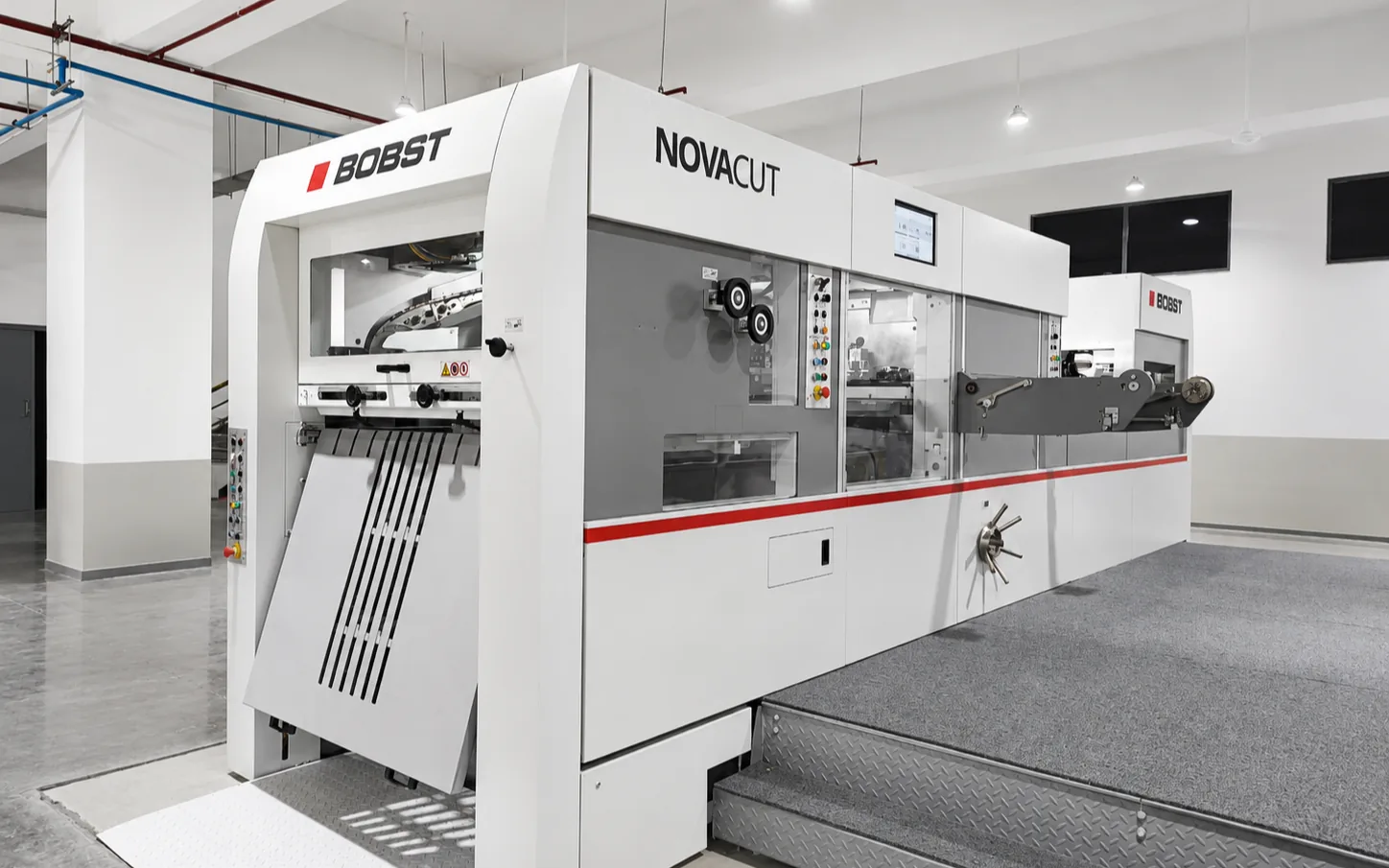
The slot is cut on the same die as the outline, through the flat sheet, before anything folds. The fold-back and its glue line run inline on the Novafold with the rest of the carton, so a hang tab adds no operation and no second supplier. What is checked afterwards is that the two layers are flush and that a loaded carton hangs level.
Cartons here are made on bulk production runs, and the cost per carton falls as the run grows, because plates, tooling and make-ready are fixed per run rather than per carton. A quote is priced against the volume you are planning. Landed pricing typically runs 20 to 30 percent below comparable US supplier quotes for the same specification. The quote is one landed price: the cartons, tooling, structural design, proofing, the documents that travel with the order, import duty, shipping and delivery to your address, in the US or anywhere else. Nothing is quoted on top of it later.


The tab goes on a carton construction. These are the three it is cut into most often here.
The usual host. Both flaps to the rear, so the front panel under the tab is unbroken.
See the structure: Straight tuck endThe economical host, for a multi-SKU program where most of the range hangs.
See the structure: Reverse tuck endWhere the pack has to be seen as well as hung. The aperture and the slot are cut on the same die.
See the structure: Window boxesVitamins and supplements are sold on peg walls as often as on shelves, and usually both at once across different accounts. The supplement hub takes the format decisions further into that category: bottle cartons, gummy packs, the Supplement Facts panel and the fitments that sit around them.
Supplement packaging
A hang tab box is an ordinary folding carton with an extension above its top panel, folded back on itself and slotted, so the carton hangs from a peg hook. The tab is cut as part of the same blank and glued back on itself inline, which is what distinguishes it from an adhesive hang tab applied to a finished carton.
Because a slot cut in a single thickness of board tears out. The load on a peg is small but it is repeated hundreds of times, concentrated on one small arc of board where the hook bears, and single thickness board creases there, then delaminates, then tears. Folding the tab back doubles the board at that point and gluing the faces together stops them working against each other. The slot is then cut through both layers at once, so they are in register by construction.
Euro slot unless there is a reason not to: it is the keyhole shape most retailers expect, and the narrow neck below the hole holds the carton square on the hook. A delta tab is a triangular hole that seats on a wider range of hook diameters and lets the tab be shorter, which saves board; it also lets the pack swing a little more, which is invisible on a light pack and noticeable on a heavy one. A rocker tab is the third option, creased so the carton angles toward the shopper on a high peg wall.
Because the carton hangs from a single point and rotates until its center of mass is below the slot. A slot centered on the tab with the product sitting to one side inside the carton will hang at an angle for the whole of its retail life. The fix is to place the slot against the loaded carton rather than against the blank, which means sending the product rather than only its dimensions.
Yes. The tab folds flat behind the carton, so the pack stands and stacks exactly as it would without one. That is the usual reason a program specifies a tab on the whole run rather than on part of it: one dieline covers the peg accounts and the shelf accounts, and the only cost is the board the tab uses.
Any of them. Tuck end, auto lock bottom, seal end and window cartons all take one, because the tab is cut into the flat blank and the blank is what differs between the constructions. The usual host is a straight tuck end, where the front panel below the tab is unbroken. The host sets how much room there is above the top panel for the tab.
Yes, and send it loaded, because where the slot sits is decided by where the filled pack balances. The structure is measured, board and caliper matched, and color matched to your existing standard under D65 and TL84 viewing conditions. Most switching programs are matched from a sample rather than rebuilt from a specification.
Last reviewed
Where the slot goes is decided by where the pack balances, and an empty carton balances differently from a full one. Send the product and say how it sits inside, and the tab comes back placed, with a prototype to hang before anything is tooled. A packaging planner replies within one business day.