FINISHES
MetPET metallic board boxes
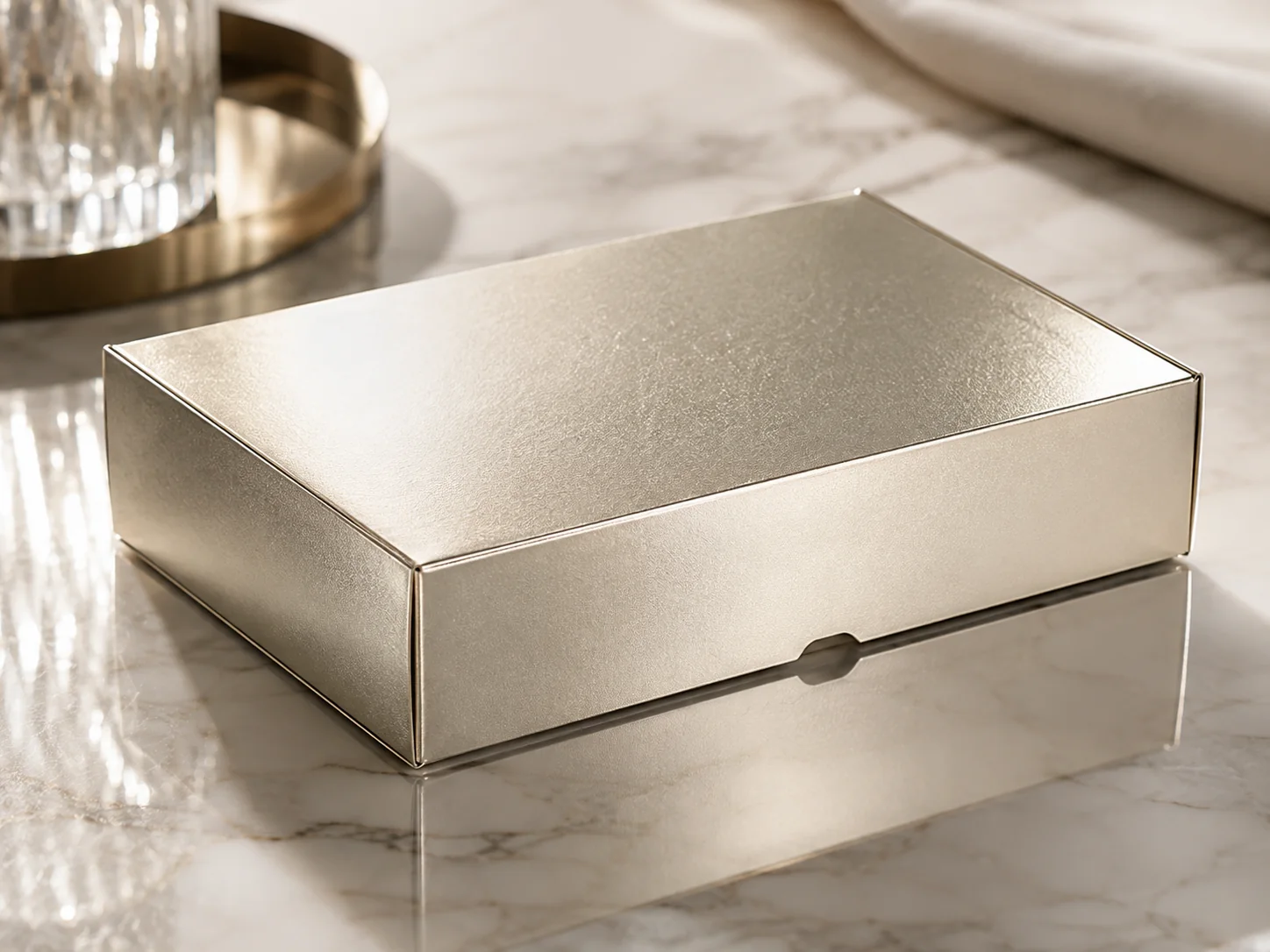
MetPET board is paperboard laminated with a metallized polyester film, so the metallic surface covers the whole carton instead of selected areas. Printing sits on top of the metal layer, so process colors go translucent and any area that has to look solid needs a white underbase.
What it is
A board, not a pass
Metallized film laminated to paperboard before anything is printed.
Timing
Before anything prints
It is the one finish here that cannot be added to a carton afterwards.
Colors
Go translucent
Process inks read as tinted metal. Anything solid needs a white printed under it.
Best at
Metal as the ground
For metal as the mark, a foil die is cheaper.
The metal is under the ink
Every other finish on this site is applied to a printed sheet. This one is the sheet, and the order of the stack is what makes process color behave the way it does over it.
A cross-section showing how MetPET board is built up, in 5 steps.
- Board. Paperboard, before anything is printed on it. This is the one finish in the family that is decided at the point the board is ordered.
- Metallized film. A metallized polyester film is laminated to the board. From here on the sheet has a mirror where every other sheet in the plant has white.
- Ink over the mirror. Process inks are translucent. Printed over a mirrored ground they read as tinted metal rather than as flat color, which is a real effect rather than a fault.
- UV curing. Film does not absorb ink the way board does, so nothing dries into it. The inks are UV inks, and the lamps cure them on the sheet before it reaches the pile.
- The white underbase. Anything that has to read solid needs a white printed under it first, including white type. It takes a press unit of its own, which is what the spare units are for.
01Board
Paperboard, nothing printed yet
Cross-section, magnified. Not to scaleHover a layer to name it
01/05Step through it
MetPET board specification
MetPET is a substrate, not an operation. Almost every row below is about what happens to the print. The finishes we run are all set out this way.
The board
- Construction
- A metallized polyester film laminated to paperboard before anything is printed.
- Decided at
- Substrate stage. It cannot be added to a carton after printing, unlike every other finish on this site.
- Coverage
- The whole carton. The metal is the ground, and anything that is not metallic has been printed over it. Most often fragrance and spirits packaging, usually as a sleeve.
What happens to the print
- Print behavior
- Process colors go translucent over the metal layer and read as tinted metal, not as flat color.
- White underbase
- Required for any area intended to read solid, including white type and any panel that has to look like paper.
Converting, and what happens after
- Recycling
- Not repulpable in most streams. The metallized film has to be separated from the fiber and most municipal streams will not do it.
- Also called
- Foil board, metallized paperboard, mirror board, Met-PET, foil laminated board.
Send the artwork and we will mark the underbase
Every area that has to read solid over the metal needs a white behind it. We will show you which parts of your design those are before the board is ordered.
MetPET vs foil stamping, metallic ink and cold foil
Four ways to put metal on a carton, often asked for interchangeably. The first row covers most of the difference.
| Compared on | MetPET board | Foil stamping | Metallic ink | Cold foil |
|---|---|---|---|---|
| How the metal gets there | A metallized film laminated to the board before print | A heated die transfers foil onto the printed sheet | Metallic pigment printed as an ink | Foil laminated in line onto a printed adhesive |
| Coverage | The whole carton, as the ground | Only where the die touches | Anywhere a plate puts it | Anywhere the adhesive is printed |
| Cost direction | A substrate cost, flat regardless of how much metal shows | Priced by coverage area | Lowest of the four | Priced by area, and cheaper than hot foil at scale |
| Print behavior | Colors go translucent. A white underbase is needed for anything solid | Nothing prints over it | Behaves as ink, and can be overprinted freely | Overprinting is normal and is how other metals are built |
| Recyclability | Not repulpable in most streams | The foil layer is a contaminant, minor on a small mark | No change. It is ink | A contaminant in proportion to the area covered |
| Best use | Metal as the background of the pack | Metal as the logo, crest or rule | Metal as a color, not a surface | Large metallic areas on long runs |
If the metal is the background, use MetPET. If the metal is the logo, use a foil die.
How MetPET runs here
MetPET is specified before printing
Every other finish on this site is applied to a printed sheet. MetPET is laminated to the board before it reaches the press, so the specification is settled when the board is ordered.
The white underbase takes a press unit of its own
Ink over a mirrored ground reads as tinted metal, so anything that has to look solid needs a white printed under it first. Six units make that one pass instead of two, using the two spare press units.
The seam and the crease are checked
A metallized surface is not fiber, so the adhesive has something different to key to and the board creases differently. Both are tested on a MetPET blank.

A mirrored ground with print over it
One panel of metallized board carrying the same artwork twice: printed straight onto the metal so the colors go translucent, and again over a white underbase so they read solid.
Cost logic
MetPET is a board choice, so the cost sits in the substrate rather than in a separate operation. Foil stamping is priced by coverage area, so the two cross over as metallic coverage grows.
A crest in foil is far cheaper than a metallic board. For a face that is mostly metal, the board can cost less.
What it costs against a US supplier
Landed cost runs 20 to 30 percent below a comparable US supplier quote. That is one price: board, printing, finishing, tooling, import duty, shipping and delivery to your door, with nothing added later.
Get a quoteQuestions about MetPET board
Paperboard laminated with a metallized polyester film, so the metallic surface covers the whole face of the carton instead of selected areas. It is a substrate, not a finish. The lamination happens before anything is printed, so it has to be specified when the board is ordered. Foil board, metallized paperboard and mirror board are the same material under other names.
Full coverage metallic is MetPET. Selective metallic is foil stamping. If the metal is the background, use MetPET. If the metal is the logo, use foil. The cost follows the same rule: MetPET is a flat substrate cost regardless of how much metal shows, and foil is priced by the area the die covers, so the two cross over as metallic coverage grows across the face of the pack.
Yes, with one thing built into the file. Process inks are translucent, so printed over a mirrored ground they read as tinted metal rather than as flat color, and anything that has to look solid needs a white underbase printed beneath it first. That includes white type and any panel meant to look like paper. It changes the build. A design drawn for white board will print differently on metal.
Embossing is the pairing that comes up most, because relief on a mirrored ground catches light twice, and it is checked against the film before tooling is cut. Foil over MetPET is unusual: the surface is already metal, so a gold foil crest on a champagne metallic ground is a small difference in tone rather than the contrast a foil block is normally specified for. Where a design wants both metal and a different metal, it is usually cheaper to print the ground and foil the mark.
A white underbase layer. Every area that has to read as solid color rather than tinted metal needs a white printed beneath it, including white type and any panel meant to look like paper, and that layer is supplied as its own separable layer rather than described in an email. Everything else in the file is a normal carton build. Send the artwork before the board is ordered and we will mark which parts of the design need the underbase.
Not in most streams. The metallized polyester film has to be separated from the fiber before the fiber can be repulped, and most municipal recycling will not do that, so a MetPET carton is harder to recycle than a coated or a laminated one. If a recyclable substrate is a stated requirement on the brief, specify foil stamping on plain board. It covers less area, looks different and keeps the stream simple.
Last reviewed
MetPET swatches, with and without underbase
The swatch carries one piece of artwork printed straight onto metallized board and again over a white underbase. Send the design with the request and the underbase comes back marked on your file.